
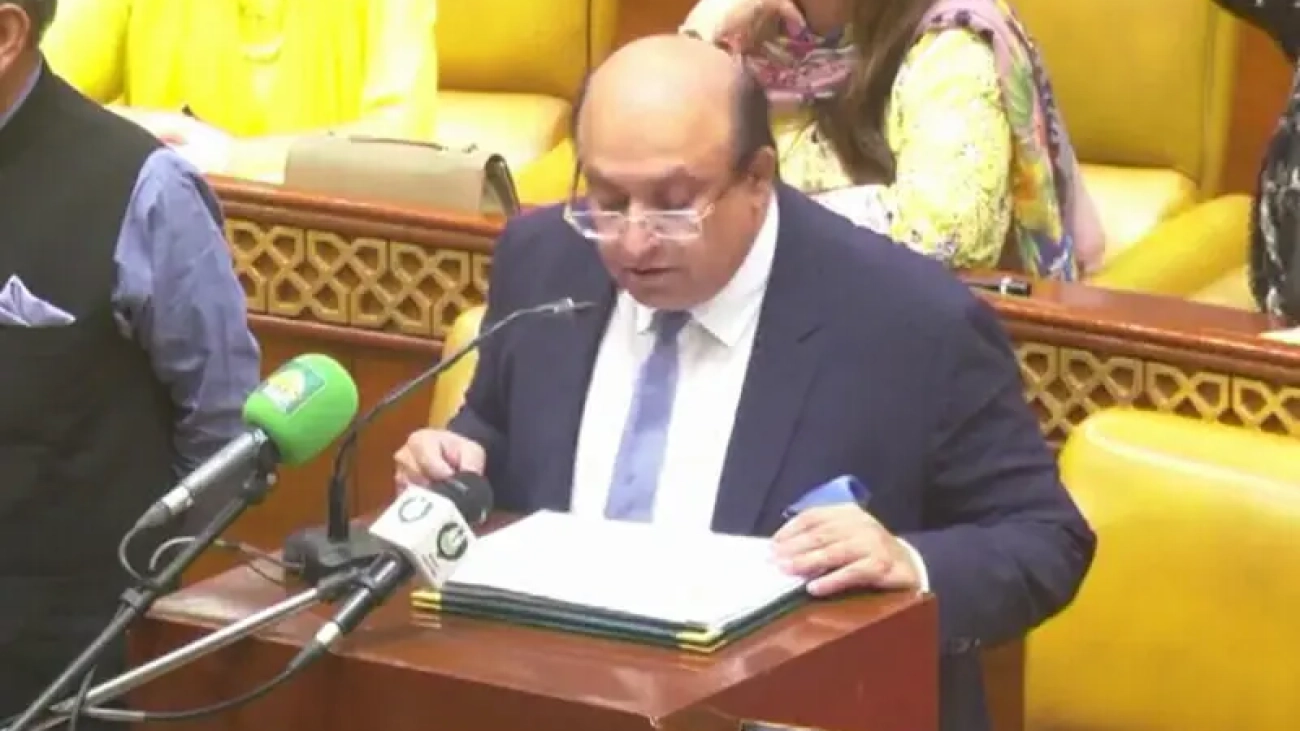
LAHORE: Punjab Finance Minister Mian Mujtaba Shuja-ur-Rehman presented a Rs5.903 trillion budget for the fiscal year 2026-27 in the Punjab Assembly, outlining an extensive roadmap aimed at accelerating economic growth, expanding social welfare, improving public services and strengthening infrastructure across the province.
The assembly session began under the chairmanship of Speaker Malik Muhammad Ahmad Khan and was attended by Punjab Chief Minister Maryam Nawaz.
Finance Minister Highlights Economic and Political Achievements
Opening his budget speech, the finance minister congratulated the nation on the Iran-US peace agreement and extended congratulations to Nawaz Sharif, Prime Minister Shehbaz Sharif and Field Marshal Syed Asim Munir.
He praised Chief Minister Maryam Nawaz for introducing what he described as revolutionary reforms in Punjab and said the government had maintained development spending despite economic challenges through fiscal discipline and austerity measures.
According to the minister, Punjab contributed Rs546 billion to the federation and has provided more than 400,000 jobs on merit while continuing to expand public services throughout the province.
Tax Relief Measures and Incentives for Citizens
The government announced that no additional financial burden would be imposed on the public despite economic pressures.
Among the key relief measures, the late payment surcharge on property tax has been eased, while property tax collection will now be conducted quarterly instead of monthly. A five percent concession under the Self-Assessment Scheme has also been introduced to encourage tax compliance.
The minister further announced that token tax exemptions on electric vehicles would increase from 95 percent to 99 percent. In addition, the cotton fee has been abolished completely to benefit farmers and Pakistan’s textile industry.
Punjab Economic Transformation Plan Unveiled
The finance minister said Punjab contributes 55.7 percent to Pakistan’s GDP and has a population of nearly 130 million people. Punjab’s per capita income has reached $1,904, reflecting a 47 percent increase over the past three years.
He announced the Punjab Innovative for Value initiative and introduced the PIVOT roadmap designed to drive economic transformation.
The government’s three-year economic strategy includes total investments of approximately Rs1.995 trillion, including Rs1.09 trillion in public-sector investment and Rs905 billion from the private sector.
Investment Targets Across Key Sectors
Under the three-year plan:
- Rs1.188 trillion will be invested in industry.
- Rs586 billion will be invested in agriculture.
- Rs230 billion will be allocated to livestock.
- Rs642 billion will be invested in tourism.
- Rs190 billion will be allocated to aquaculture.
- Rs186 billion will be invested in skills development.
- Rs64 billion will be allocated to the IT sector.
The programme is expected to generate $6.8 billion in additional exports and create approximately 162,000 jobs.
Budget Size, Revenue Targets and Development Spending
The proposed budget of Rs5.903 trillion is 10.7 percent higher than the current fiscal year’s budget.
Current expenditures are estimated at Rs1.963 trillion, while Rs752 billion has been allocated for development spending.
Punjab is expected to receive Rs4.391 trillion under the NFC Award, while the provincial revenue target has been set at Rs1.209 trillion.
Revenue collection targets include:
- Rs528.5 billion for the Punjab Revenue Authority.
- Rs86.19 billion for the Board of Revenue.
- Rs124 billion for the Excise and Taxation Department.
Education Sector Receives Rs750 Billion Allocation
The education sector has been allocated Rs750 billion, including Rs63.3 billion for development projects.
The government plans to distribute 110,000 laptops under the Chief Minister’s Laptop Programme at a cost of Rs27 billion. A total of 42,000 laptops have already been distributed during FY2025-26.
The Honhaar Scholarship Programme will receive Rs15 billion, while a School Meal Programme in 13 districts has been allocated Rs4 billion to address child malnutrition.
Additionally, IT laboratories will be established in 244 colleges at a cost of Rs6.9 billion, benefiting more than 447,000 students.
Rs500 Billion Proposed for Healthcare
The government has proposed Rs500.62 billion for the health sector, including Rs76.3 billion for development expenditures.
A sum of Rs20 billion has been allocated for the Nawaz Sharif Institute of Cancer Treatment and Research, while plans were announced to establish the Nawaz Sharif Institute of Cardiology in Sargodha and the Jinnah Institute of Cardiology in Lahore.
The finance minister also highlighted investments in health clinics, dialysis services, heart surgeries, transplant programmes and the proposed Nawaz Sharif Medical District.
Business, Industry and Employment Initiatives
To encourage entrepreneurship and investment, the government will introduce schemes worth Rs47.7 billion.
Through the Asaan Karobar initiatives, more than 110,000 entrepreneurs have already received interest-free loans totaling Rs125 billion.
Industrial development projects include Garment City in Sheikhupura, the Allama Iqbal Industrial City project in Faisalabad and a Rs35 billion Industrial Estates Development Programme.
The government also announced support programmes for sports goods, cutlery, ceramics, fan manufacturing and export-oriented industries.
Housing, Water and Social Welfare Programmes Expanded
The budget allocates Rs507 billion for water and sanitation projects.
Under the Apni Chhat Apna Ghar Programme, more than 173,000 housing loans have already been issued. During the next fiscal year, the government plans to provide Rs300 billion in interest-free loans to 200,000 beneficiaries.
Social welfare programmes receiving funding include:
- Himmat Card Programme
- Livestock Card Programme
- Maryam Nawaz Social Security Rashan Card
- Dhee Rani mass marriage initiative
Special allocations have also been proposed for persons with disabilities and low-income families.
Minority Welfare and Women Empowerment Measures
The government has allocated Rs5 billion for the restoration and development of religious and historical sites and plans to introduce a CM Minority Card scheme worth Rs3 billion.
Women-focused initiatives include IT training programmes, vocational training opportunities and the construction of Lady Bar Rooms across Punjab to improve professional facilities for female lawyers.
Smart Cities, Security and Skills Development
The finance minister announced continued expansion of Smart Safe Cities projects and regional data centres at a total cost of Rs47.1 billion.
New police stations, police posts and crime scene units will also be established to strengthen law enforcement capacity.
Meanwhile, the Chief Minister Skills Development Programme and the CM Skilled Punjab Programme will provide market-oriented training and overseas employment opportunities for young people.
Major Investments in Public Transport and Roads
Punjab has launched mass transit projects in Faisalabad and Gujranwala at a total cost of Rs143 billion.
The government is also pursuing the purchase of 1,100 electric buses worth Rs94 billion and has proposed a further Rs168 billion project to introduce 2,000 additional electric buses across the province.
Road infrastructure remains a major focus, with ongoing rehabilitation, restoration and expansion projects throughout Punjab. The government has proposed Rs36 billion for the completion of ongoing road schemes and additional allocations for urban development and strategic infrastructure improvements.
Government Aims for Long-Term Growth
Concluding his speech, the finance minister said the budget aims to strengthen Punjab’s economy through investment, exports, infrastructure development, education, healthcare improvements and targeted social welfare programmes, while maintaining fiscal discipline and avoiding additional burdens on the public.