
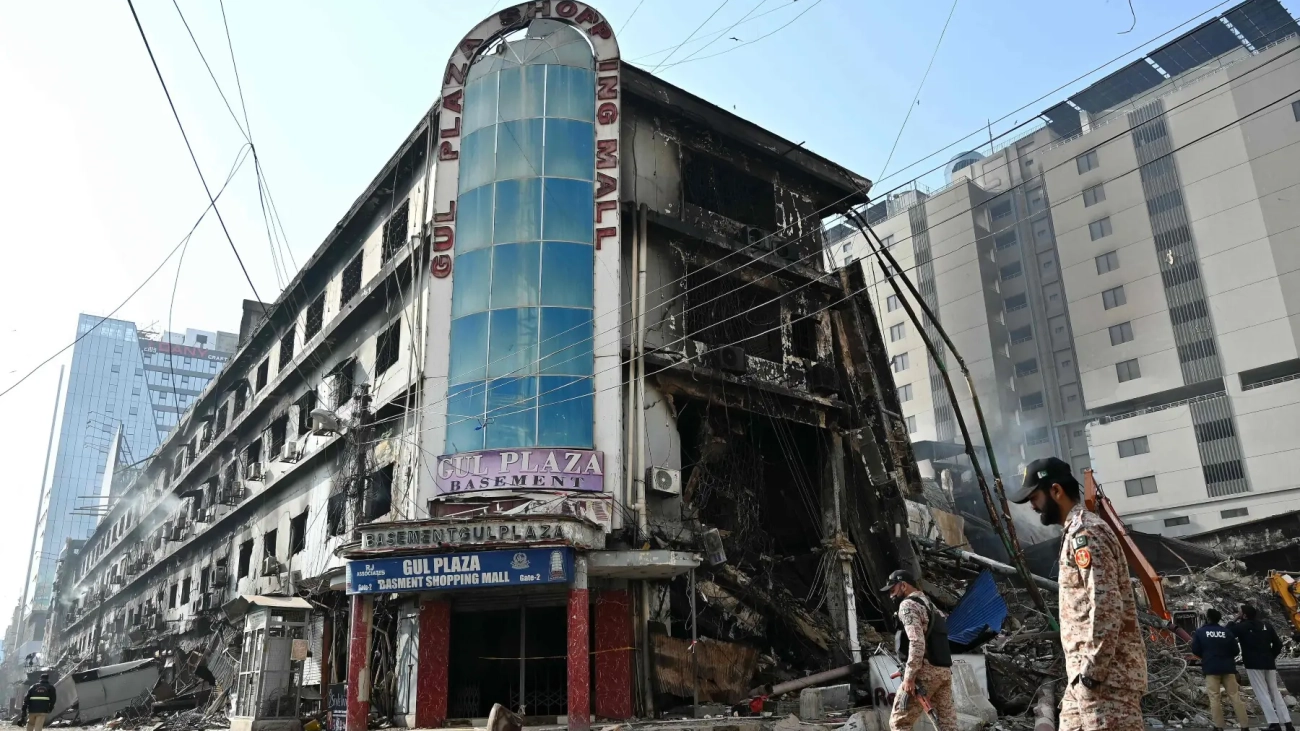
KARACHI: The Sindh Home Department has released the judicial commission’s report into the Gul Plaza fire, concluding that the shopping centre remained in commercial use despite being declared hazardous and violating fire-safety regulations, while its administration failed to rectify known deficiencies.
The commission examined the responsibilities of various parties involved in the tragedy and identified multiple institutional and administrative failures that contributed to the loss of life.
According to the report, Civil Defence inspections conducted in 2024 and 2025 had already identified the absence of essential fire-safety equipment at Gul Plaza. The reports also flagged the presence of combustible materials and deficiencies in emergency exits.
Despite these findings, no effective measures were taken to address the identified shortcomings, the commission observed.
The report said the notification of the fire to the fire brigade was delayed in an “extremely unwise” manner. The subsequent disconnection of electricity plunged the building into darkness, further reducing the chances of people on the upper floors escaping.
Although a speaker system was installed in the building, it was not used during the emergency, the commission found.
The report also highlighted overcrowding and the excessive presence of combustible goods. While the regularised plan of Gul Plaza provided for 1,102 shops, there were actually 1,153 shops operating in the building.
Rescue Response Also Questioned
The judicial commission raised serious questions about the response of the fire brigade and rescue authorities.
It said the fire brigade took longer than its own prescribed response standards to arrive, while effective firefighting operations began approximately 35 to 40 minutes after the incident.
A shortage of water and the need for refilling affected both firefighting and rescue operations. The commission termed the failure to ensure an effective initial water supply, despite claims that water was available at fire stations, a significant administrative question.
The report further stated that emergency personnel arrived after the fire had broken out, but an opportunity for an effective rescue operation still remained.
According to the commission, rescue was possible between 11:00am and 11:20am, when some victims could still be seen. Access to the building through the ramp also remained possible until around 11:30am, but Rescue 1122 failed to turn the available window into a large-scale rescue operation.
The commission concluded that people died not only because of the fire but also because of delays, darkness and blocked exits. It said the failure to use available rescue opportunities in a timely manner contributed to the death toll.
Multiple Institutional Failures Identified
The report said the deficiencies identified in 2024 and 2025 were not followed by effective corrective action. Even after the courts became operational in 2025, legal proceedings were not taken forward effectively.
The commission said Civil Defence’s failure was not due to a lack of awareness of the danger, but rather a failure to ensure implementation of safety requirements.
It also observed that the Sindh Building Control Authority (SBCA) could not escape responsibility merely by maintaining that inspections were conducted on the basis of complaints.
The report identified failures in the building’s safety systems, auditing mechanisms, institutional coordination, firefighting arrangements and emergency response.
It further noted that the law required regular inspection of electrical installations and equipment. However, according to the statement of the Electrical Inspector, no formal electrical inspection of Gul Plaza had been carried out.
The commission concluded that responsibility for the tragedy could not be confined to a single institution or a single government. Various institutions exercising legal, regulatory, building-control, firefighting and emergency-response functions existed during different periods, but the overall system failed to operate effectively.
Fire Claimed More Than 70 Lives
The Gul Plaza fire broke out on January 17, 2026, at the well-known shopping centre on Karachi’s M.A. Jinnah Road.
The blaze continued for three days, killing more than 70 people, while the shopping centre was completely destroyed.
The judicial commission’s findings point to a combination of known safety violations, inadequate enforcement, delayed emergency response and institutional failures as key factors behind the scale of the tragedy.